All you need to know about Industrial Pins

Updated: Jan 9
In the world of mechanical engineering and manufacturing, the smallest components often carry the heaviest loads. Industrial pins are the perfect example. While they may look like simple pieces of hardware, they are essential for aligning, pivoting, and securing components in everything from car engines to aerospace assemblies.
1. What is a Pin?
In a mechanical context, a pin is a non-threaded fastener designed to be inserted into a pre-drilled hole. Unlike bolts or screws, which rely on threads to generate clamping force, pins typically use friction, tension, or shear strength to hold parts in place.
Their primary functions include:
Alignment: Ensuring two components are perfectly positioned.
Fixing: Locking parts together to prevent relative movement.
Pivoting: Acting as an axis for moving parts (like a hinge).
2. Main Types of Pins and Their Applications
Choosing the right "style" of pin is critical for machine safety and performance. Here are the most common types used in modern industry:
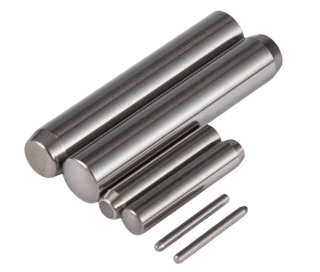
Dowel Pins
These are solid, cylindrical rods machined to incredibly tight tolerances.
Use Case: Precision alignment in motor housings and jig assemblies.
Industry: Automotive and Tool & Die manufacturing.
Spring Pins (Roll Pins)
These pins are hollow and "split" down the side. They are slightly larger than the hole they are meant for; when driven in, the tension holds them firmly in place.
Use Case: Securing gears to shafts where vibration is present.
Machine: Power tools and agricultural equipment.
Cotter Pins
A split metal pin with two tines that are bent after insertion.
Use Case: Often used to secure a clevis pin or a "castle nut."
Industry: Heavy machinery and bicycle repair.
Clevis Pins
A headed pin with a hole at the end for a cotter pin. It acts as a movable shackle.
Use Case: Connecting a tractor to a trailer or acting as a hinge point.
Machine: Hydraulic cylinders and rigging hardware.
Taper Pins
These pins have a diameter that gradually increases from one end to the other.
Use Case: Driven into tapered holes to ensure a permanent, tight fit that won't wiggle loose.
3. How to Choose the Right Type of Pin
Selecting a pin isn't just about size; it's about the physics of your machine. Consider these four factors:
Load Requirements: Will the pin experience Shear Stress (force pushing from the side) or Tension? Solid dowel pins are better for high shear, while spring pins handle vibration better.
Material & Environment: * Stainless Steel: For food processing or marine environments (corrosion resistance).
Alloy Steel: For high-strength industrial machinery.
Removability: Do you need to take the machine apart frequently? If so, a Quick-Release Pin or Lynch Pin is better than a permanent Taper Pin.
Tolerance: For precision alignment, you need a pin with a "Ground" finish (very smooth and accurate). For basic fastening, a standard roll pin suffices.
4. Where You’ll See Them (Industries & Machines)
Industrial pins are the "glue" that holds mechanical systems together across various sectors:
Aerospace: Used in wing assemblies and landing gear for high-vibration resistance.
Automotive: Found in transmissions, steering columns, and engine blocks.
Construction: Heavy-duty clevis pins are used in cranes and excavators.
Consumer Electronics: Micro-pins are used in hinges for laptops and foldable devices.
Summary Table: Quick Reference
Pin Type | Key Benefit | Common Machine |
Dowel | High Precision | Engine Blocks |
Spring | Vibration Resistance | Conveyor Drives |
Cotter | Secondary Security | Wheel Axles |
Clevis | Easy Connection | Towing Hitches |


Comments